How AI Agents Talk to Each Other

The Airport That Never Sleeps
Picture this.
You're running late for an international flight. Panic sets in. You rush to the check-in counter, barely make it through security, clear immigration somehow, and collapse into your seat just as the boarding doors close.
From your side, it felt chaotic. But from the airport's side? Everything went exactly as it should.
Here's what actually happened behind the scenes.
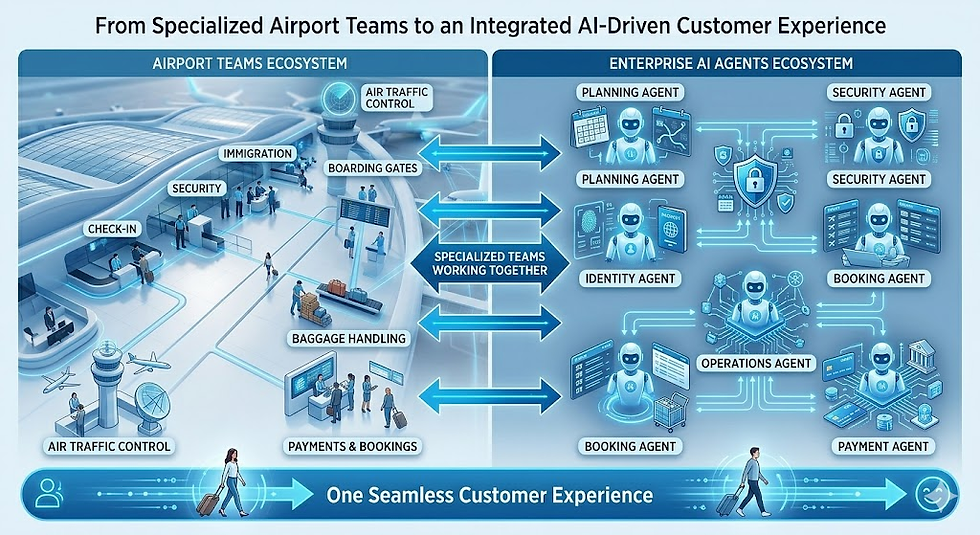
The moment you were flagged as a late passenger, a chain of coordinated actions kicked in. Check-in staff confirmed your booking. Security was notified. Immigration fast-tracked your documents. The boarding team held the gate for an extra four minutes. Ground operations made sure your bag made it onto the aircraft.
No single person managed all of that. No single system controlled every step.
Each team specialized in one thing, communicated through well-defined processes, and together delivered what felt like a miracle — but was actually just good coordination.
Now hold that thought.
From One AI Assistant to an Ecosystem of Agents
For the past two years, the conversation around enterprise AI has been dominated by one question: how do we build a smarter model?
Bigger context windows. Better reasoning. Faster responses. The race to build the most capable single AI assistant has been relentless.
But something more interesting is quietly happening underneath that conversation.
Organizations are realizing that the hardest enterprise problems don't need a smarter single AI. They need multiple specialized AIs that know how to work together.
Think about something as routine as an insurance claim.
One AI system needs to understand the customer's request. A second validates policy coverage. A third scans for fraud patterns. A fourth estimates repair costs. A fifth calculates the settlement and triggers reimbursement.
Five different responsibilities. Five different kinds of expertise. One seamless experience for the customer — if, and only if, these agents can actually communicate.
That "if" is where most enterprise AI implementations quietly fall apart today.
The question is no longer how do we build a smarter AI?
The real question is: how do specialized AI agents discover each other, exchange information, and access enterprise systems — reliably, securely, and at scale?
The Three Questions Every Agent Must Answer
Let's go back to the airport.
When a late passenger arrives, every team involved has to answer three questions almost instantly:

Who should handle the next step?
What information needs to be exchanged?
Which systems need to be accessed right now?
Get any one of those wrong, and the passenger misses the flight.
Specialized AI agents face the exact same challenge. Before they can complete any meaningful task together, each agent needs to answer:
The Question | The Emerging Answer |
|---|---|
Who can help me with this task? | Agent Discovery (ADR) |
How do I collaborate with another agent? | Agent-to-Agent Communication (A2A) |
How do I access enterprise tools and systems? | Model Context Protocol (MCP) |
Where do I find additional business knowledge? | Retrieval-Augmented Generation (RAG) |
How do enterprise applications exchange data? | APIs |
These aren't competing standards fighting for dominance. They're complementary layers — each solving a different piece of the collaboration puzzle.
Let's briefly unpack each one.
Agent Discovery (ADR) is how an agent finds the right specialist for a task it can't handle alone. Think of it as the airport's internal directory — the check-in agent doesn't need to know everything about immigration. It just needs to know who handles immigration and how to reach them.
Agent-to-Agent Communication (A2A) is the actual conversation between agents once they've found each other. It defines how they exchange information, hand off tasks, and stay synchronized — the equivalent of two airport departments calling each other on a shared radio channel with a common language.
Model Context Protocol (MCP) is perhaps the most foundational of these three. It standardizes how AI agents connect to enterprise tools — databases, APIs, SaaS platforms, internal applications. Without MCP, every new agent integration requires custom development from scratch. With it, agents plug into enterprise systems the way your phone plugs into any USB-C charger — one standard, universal access.
RAG enriches an agent's response with relevant business knowledge it doesn't already carry — pulling from documents, policies, or knowledge bases in real time.
And beneath all of this, APIs continue to do what they've always done: connect enterprise applications at the data level.
The Invisible Layer That Makes It All Work

Here's what passengers never think about at an airport.
There is an entire invisible communication infrastructure running beneath every smooth journey. Shared radio channels. Standardized codes. Defined handoff procedures. Internal directories that route queries to the right team instantly.
Passengers don't see it. They just experience the result — a seamless journey from door to gate.
Enterprise AI is building its own version of that invisible layer right now.
As organizations move from single AI assistants to ecosystems of specialized agents, this communication infrastructure becomes the difference between a system that actually works and one that looks impressive in a demo but falls apart in production.
The agents themselves can be extraordinarily capable. But without standardized protocols for discovery, communication, and tool access, they remain isolated — brilliant specialists who can't find each other's offices.
What This Means If You're Building or Buying AI Today
Here's the practical implication that most vendor conversations skip over.
If someone is pitching you an "AI agent" solution, ask them these three questions:
How does the agent discover other agents when it needs help? If the answer is "it doesn't — it does everything itself," you're looking at a monolithic assistant dressed up as an agent.
How does it communicate with other agents in your existing ecosystem? Proprietary agent-to-agent communication that only works within one vendor's platform is a future lock-in problem, not a solution.
How does it connect to your enterprise systems? Custom integrations built one by one are expensive, fragile, and slow. MCP-based connectivity is what genuinely scalable agentic architectures look like.
These aren't technical questions. They're architecture questions. And the answers will tell you whether you're investing in a platform that grows with you — or one that quietly becomes a ceiling.
The Big Shift

For decades, enterprise software evolved by breaking large monolithic applications into smaller, specialized services. Microservices. APIs. Service meshes.
Enterprise AI is following a strikingly similar path — just compressed into a fraction of the time.
The intelligence of tomorrow's enterprise systems won't come from a single, all-knowing model. It will emerge from collaboration between specialized agents — agents that can find each other, talk to each other, and access the right systems at the right moment.
Just like an airport.
The future of enterprise AI isn't about building bigger AI.
It's about building better collaboration.
🚀 AICloudLeader Insight
Enterprise AI is not evolving toward one super-intelligent agent. It is evolving toward an ecosystem of specialized agents that discover, communicate, and collaborate through standardized protocols. The future belongs not to bigger AI, but to better orchestration.
What's Next?
The airport story we explored in this article is more than just an analogy — it represents the direction in which Enterprise AI is rapidly evolving.
The future will not be defined by a single all-knowing AI assistant. Instead, organizations will build ecosystems of specialized AI agents that discover one another, collaborate intelligently, and securely interact with enterprise systems to solve complex business problems.
As architects and engineers, understanding these communication patterns will become just as important as understanding APIs, microservices, or cloud-native architectures.
But one fundamental question still remains:
How does an AI agent securely connect to enterprise applications, databases, APIs, SaaS platforms, and business tools without requiring custom integrations every time?
The answer lies in the Model Context Protocol (MCP) — one of the foundational building blocks of the Agentic AI ecosystem.
In the next article, we'll move from the big picture to the implementation layer and explore how MCP standardizes tool access for AI agents, simplifies enterprise integration, and lays the foundation for interoperable AI systems.
This is Article 1 in the How AI Agents Talk to Each Other series on AICloudLeader. Follow along for the full series on agentic communication, enterprise integration, and the architecture of the next wave of AI.


rr88k1 com hôm bữa mình cũng tò mò bấm vào xem thử vì thấy người ta nhắc hoài. Mình không có tìm hiểu nội dung sâu đâu, chủ yếu lướt qua giao diện cho biết. Cảm giác đầu tiên là bố cục nhìn khá “ngăn nắp”, kiểu chia thành từng khối nên mắt bắt nhịp nhanh, không bị choáng vì quá nhiều thứ dồn một chỗ. Mình để ý cái menu đặt ngay chỗ dễ nhìn, chuyển qua lại vài mục thấy mượt, không phải kéo lên kéo xuống để tìm đường. Mấy phần thông tin trình bày theo dạng cột nên đọc lướt cũng hiểu ý, khoảng cách chữ vừa phải nên đỡ rối. Nói chung nhìn vài phút…